
Review of the Tiderace Pace Action
Location: England
Paddler: Male, 6ft, experienced paddler, paddling the Action for six months
Date: October 2024
Model: Tiderace Pace Action
The Pace Action is proving to be a fantastic kayak. It’s loads of fun to paddle due to it’s manoeuvrability, the rounded hull makes it easy to roll and is very easy to edge when being bongo-ed in surf – much less reliance on the paddle than my Atlantic. No correction strokes are needed in side winds/ swell/ currents etc allowing you to just concentrate on forward paddling, resulting in less effort and being fresher after a long day. I’ve encouraged a few people to try it out who are thinking of new kayak purchases. They looked at it and thought it’s an experts kayak but it’s anything but, it’s versatile, efficient (people talk about speed but I prefer to think less effort paddling in a group), and loads of fun to play in.
Touring and expeditions
The rudder and efficiency make it a lovely tourer. More than enough hatch capacity for my touring needs – four to five days of kit, grub and beer.
Personalising my sitting position
I had some initial discomfort with numb legs, cured by adding a second thin layer of foam to the seat and having a more relaxed foot rest position. I don’t need to feel as locked in as normal, yet retain a locked in position when rolling, surfing, playing in tide-races, despite having the foot pegs a notch further away. A small amount of silicone fixed a small leak between bulk head and day hatch.
Review of the Tiderace Xceed XS: performance kayak for the smaller paddler
Location: Scotland, UK
Paddler: Female, 5’2″, experienced
Date: May 2025
Model: Tiderace Xceed XS
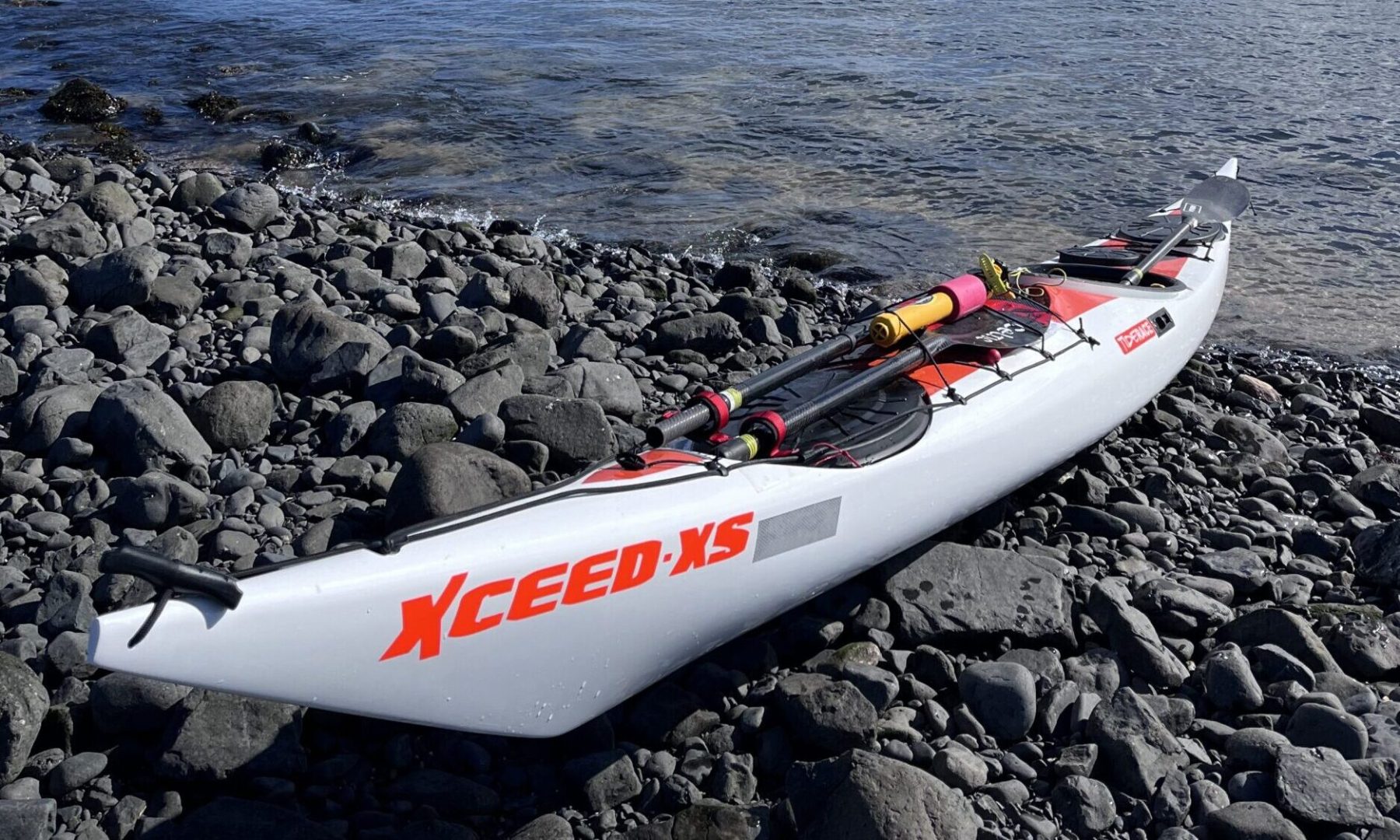
The Tiderace Xceed XS is finding a niche in the sea kayak market as a quality choice for smaller paddlers looking for performance, fit and comfort.
As paddlers we are all are unique, but some of us are shorter in height, lighter weight, shorter torso, legs, legs and arms.
Of course, due to many factors such as the flexibility of our knees and hips, the size of our feet and shoes, height to weight ratio, where we store fat and muscle, we all differ in what we find comfortable. In general, the more standard-sized paddlers have a wider range of sea kayaks to choose from across the brands. For smaller paddlers, say under 65kg, there’s less choice. Having said that, there are some well-established sea kayak models that suit smaller people. Sometimes adding padding at the hips and sometimes ballast can be useful, but nothing beats the volume and dimensions of the kayak matching the paddler right from the off.
Size and volume
This is where the Tiderace Xceed XS excels. According to the specs it is suitable for paddlers in the 45 – 75 kg range, and in my experience will fit paddlers from about 4’10- 5’7. I’m 60kg and 5’ 2” (156cm).
- Suitable paddler weight 45 – 75 kg / 100 – 165 lbs
- Overall volume 304 litres/ 66.9 gal. 510 cm
- Length 510cm / 16’ 9″
- Width 51.5 cm / 20.25”
- Cockpit 84 x 47.5 cm / 33.1 x 18.7″
Connectivity and confidence.
The Xceed XS has a shorter cockpit than other Tiderace models, with a corresponding narrower and lower deck. Straightaway, this is noticeable in making it easier to fit and remove the spraydeck.
Also, crucially, connectivity between the paddler and kayak is improved especially around the thighs and hips, so edging and turning becomes easier as our body weight has a more meaningful impact on the kayak for edging and turning and control, which is so crucial in more dynamic water. Edging makes it easy to turn, even at 16’9”.
Better catch area
With a lower and narrower deck, the area in front of the cockpit is smaller and so reaching the water with the paddle requires a more natural movement for the catch. So, with this benefit, our forward paddling can be more powerful because we can paddle without over-reaching and changing our posture.
Feel, stability and manoeuvrability
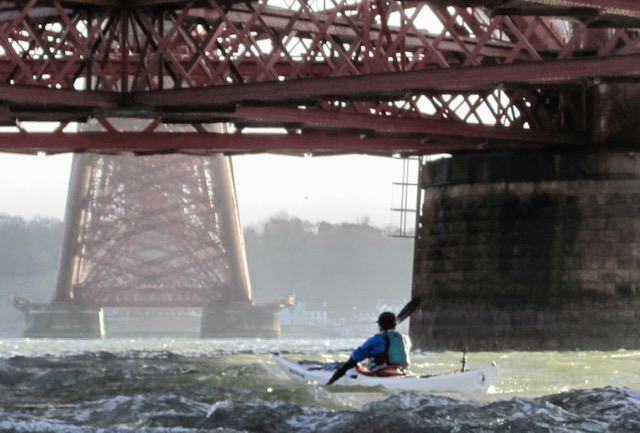
I use this mainly kayak as a day boat, only partially laden, for coaching and guiding on the sea. I need a kayak that turns well and allows me to perform in all conditions whilst looking and behaving like a traditional sea kayak. The overall stability feels somewhere between the Xplore s and the Xcape s and shares some of the feel of the Pace Action S, such as the boxier section behind the cockpit. It feels fast and responsive and like the Pace Action and excels in a following sea and surf; it takes off at the slightest hint of a waves from the stern. This kayak has transformed my enjoyment in this environment.
The increase in performance comes with a small trade off with stability, concentration is needed in certain sea states, where the Xcape s would be happy. A good, relaxed posture, and an active blade when it gets a bit more lively, soon keeps the kayak and the paddler happy.
Expedition readiness
I’ve recently tested the Xceed XS fully laden – tight squeeze but handled superbly with solid stability as expected. The carrying capacity of the hatches is always going to be lower with a small volume boat. The overall volume is 304 litres. If buying new, the front bulkhead can be moved in the production phase to maximise volume in the front hatch rather than the cockpit. This can be discussed with your dealer.
In summary, the Xceed XS is my day boat of choice for working and short overnight trips. It has improved my paddling habits and it definitely matches my paddling ambitions and where I want to be as a paddler.
Review of Tiderace Pace 17 Tour S
Location: Scotland
Paddler: Female, experienced, carrying about 20kg load, height 156cm and weight 60kg
Taking the Pace 17 Tour out to play
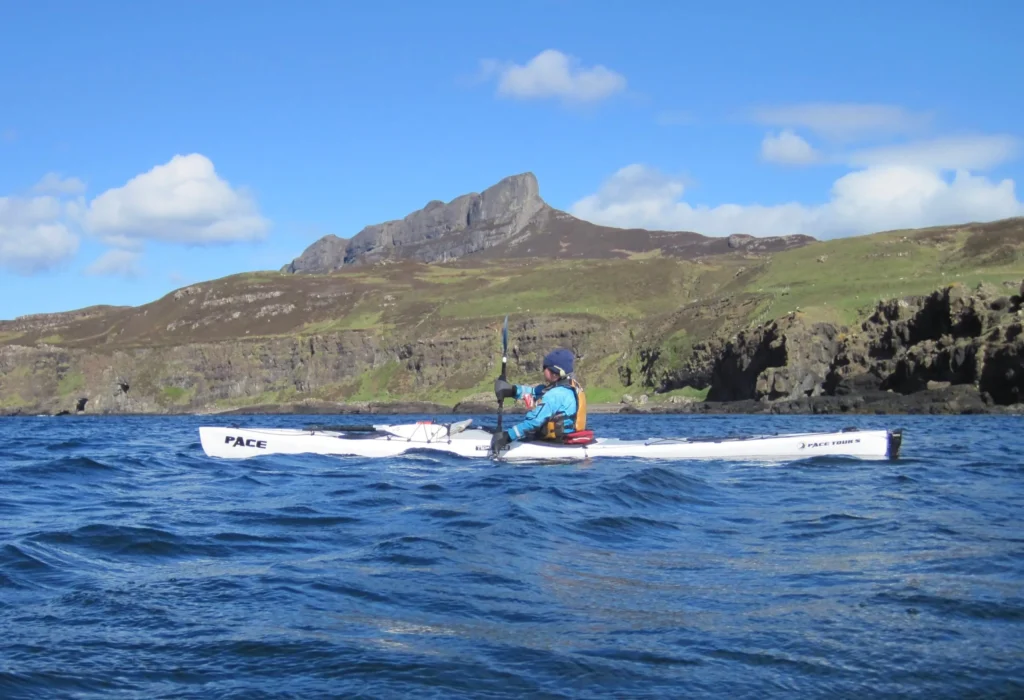
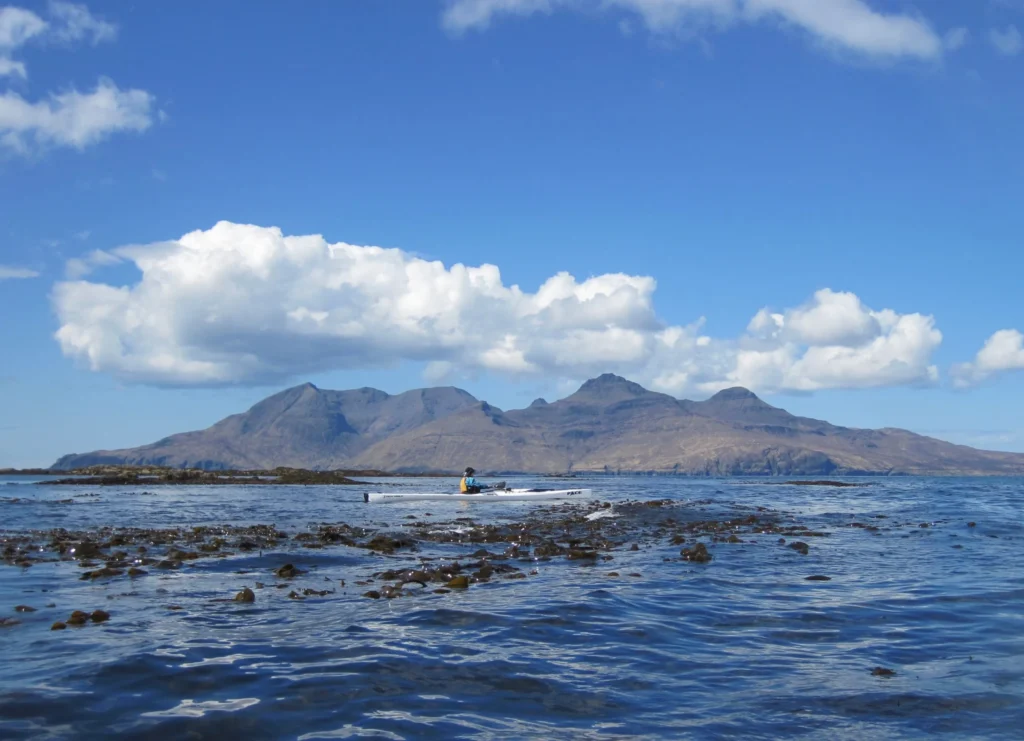
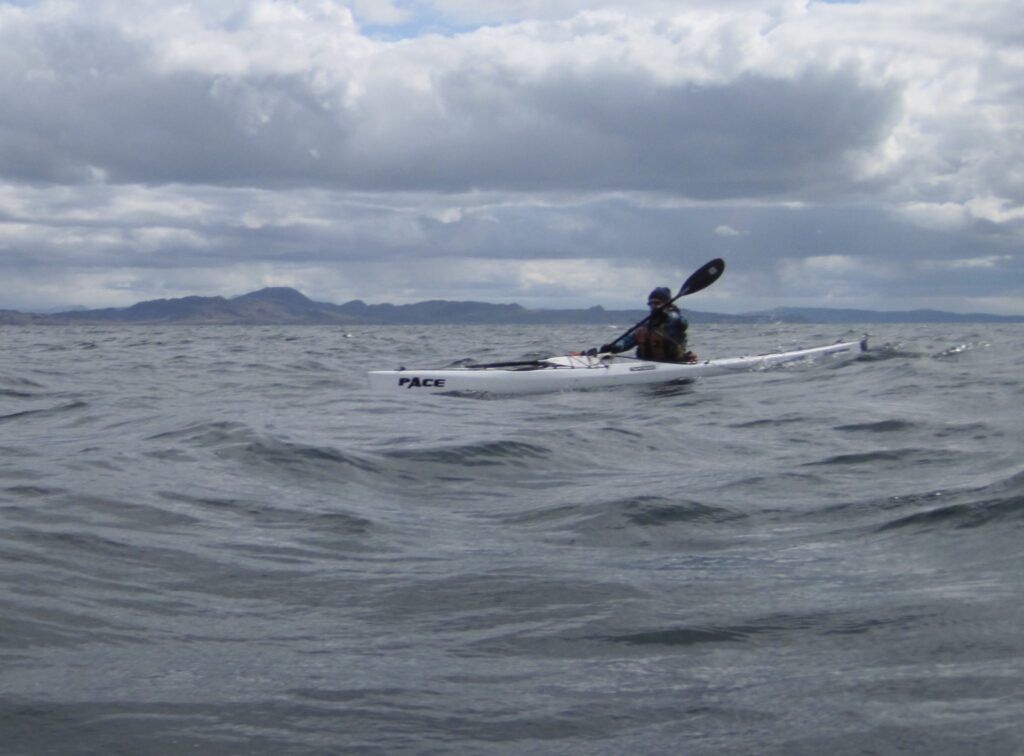
I had an opportunity to load up the Tiderace Pace 17 Tour S for a few days and try it on a sea kayak trip to islands off the west coast of Scotland. A great opportunity to test it for a review.
Visual impressions
The Tiderace Pace 17 Tour S is visually striking and definitely turns heads. The plumb line of the bow and extended waterline coupled with the rudder for precise direction control suggests speed and efficiency. Visually, there is a lot of kayak in front of the cockpit with the stern much lower and flatter. It is very aesthetically pleasing and it is the first boat of this kind that I have paddled.
Packing
This kayak is truly a delight to pack. With 163 litres of hatch space under two huge oval hatches, it was a breeze to stuff in my dry bags compared to my smaller kayaks. I packed a roomy two person tent, a four season sleeping bag, stove, fuel, food for a week, some beer and lots of warm clothes, plus the usual safety kit. It all packed in with plenty room to spare. The day hatch; a cavernous 38 litres, and the foredeck hatch are easily accessible whilst on the water and as always the Kajak Sport hatches are easy to take off and on. It really took the stress out of packing for a trip.
Same cockpit feel but a little different
Getting into the cockpit feels familiar to other kayaks I paddle regularly, (Xcape s, Xplore s) the same solid backrest and thigh gips and a smooth firm seat. The thigh braces feel a little lower than the Xplore, more akin to the Xcape.
Using the rudder
For a rudder rookie like me it’s useful to know that with the SmartTrack system, each footpeg is split into two. The lower part is for pushing against to generate force as in non-ruddered kayaks and the upper part is operated by your toes and controls the rudder. Pushing with your left foot turns the kayak left and your right foot right. For seasoned rudder users this will seem obvious I’m sure. The footpegs adjust easily with one hand and the wires which control the rudder adjust automatically using clever engineering magic. Adjust and go!
Whilst getting used to the rudder, I found when more accuracy and finesse was needed, my feet naturally reverted to behave as though I was in a kayak with a skeg, pushing on the opposite side to gain power for turning. Effectively I was performing a little dance under the deck which was more akin to fumbling around a dance floor than the ballet. No doubt I would adapt with a little more practice.
Handling characteristics
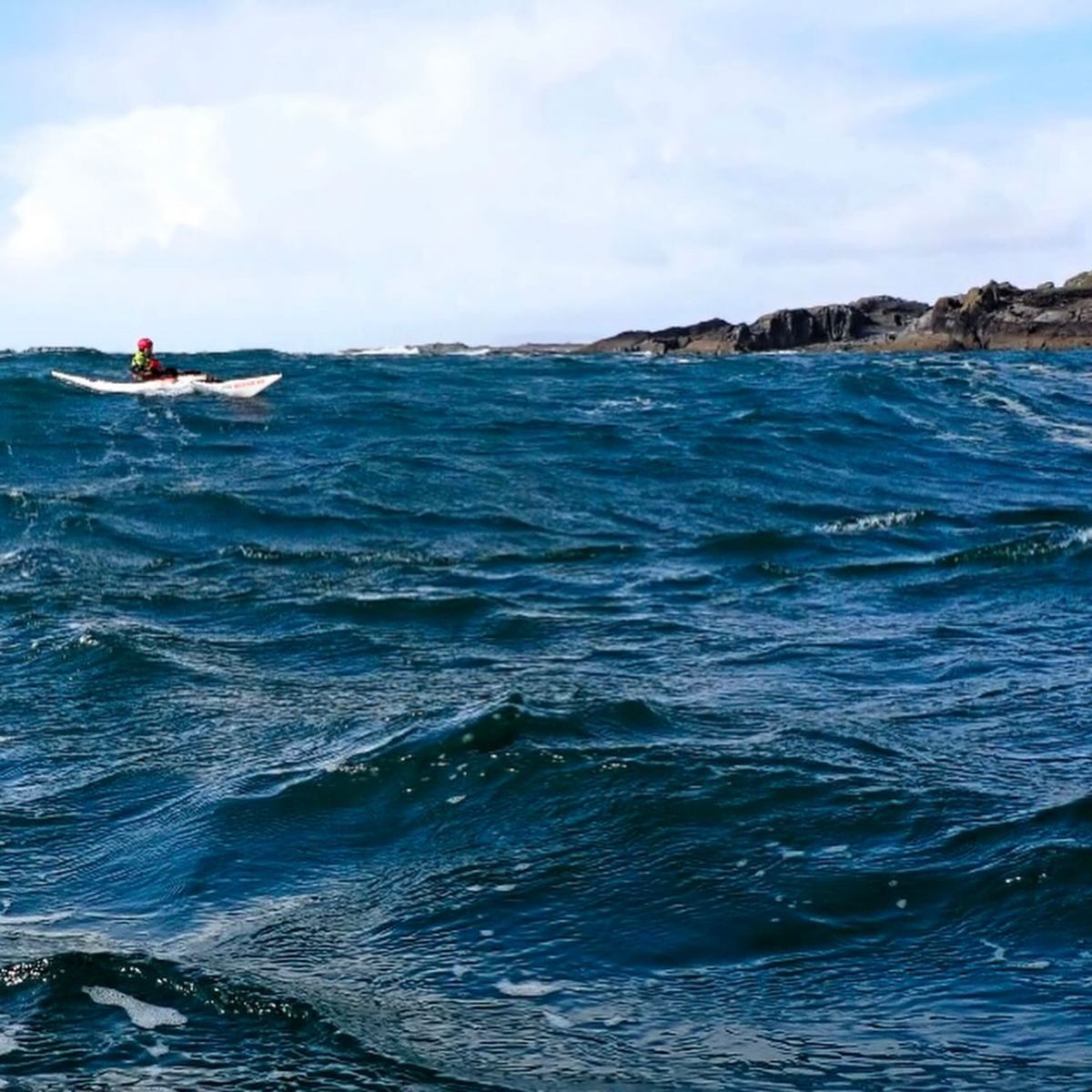
Paddling the two hours across the Sound of Eigg in a slight swell and cross wind, the Pace ate up the miles with ease. I had a good notch of effortless speed above the group and the waves on the beam were dispatched without so much as a nod.
A noticeable difference when paddling is the narrowness of the foredeck which afforded an improved position for the catch and over the duration of the trip I really started to relish.
On a longer paddle the next day around Eigg, I noticed my seating position was causing me some fatigue, I diagnosed that I needed the back support band to be closer and more snug. I’m at the bottom end of the weight and size range for this kayak so this is understandable. I fashioned a temporary bodge with a bit of foam and duct tape which made all the difference and I felt much more connected and comfortable again. Something to fix properly when back on dry land.
Crossing across to Muck in a decent following sea really allowed the Pace to excel. It has a solid stability at the stern at least compared to what I’m used to and gives confidence to catch waves and really have fun surfing.
Paddling west along the north coast of Muck, I paddled close to rocks and pulled the rudder up and found that the Pace Tour loves an edge and turned very well, feeling very stable. The slog back into the strengthening wind and quartering sea was always going to be hard work. The rudder held a good course and the kayak provided a dry ride home.
There are a few wrinkles to be ironed out to get this kayak working perfectly for me. The tension between the left and right rudder seemed unbalanced, and I’ve since learned that are little adjusters on the footpegs for that. The deck fittings are a long way away when sitting in the cockpit so I’ll consider adding a set of closer deck fittings myself, for ease of reading maps.
Finally
Overall, this kayak truly loves a big open sea with waves and swell, and it provides the reliable ride and inspires confidence for those big journeys. With the rudder up, closer to rocks and a good edge you can have plenty fun as it is still nimble enough for rock hopping and quick manoeuvrability.
Review of the Tiderace Xceed
Location: England
Paddler: Male, 6ft, experienced
Date: May 2024
Model: Tiderace Xceed made by Nelo
Finish and cockpit comfort
The first thing that is noticeable is the fantastic finish of the perfect seamless hull. Even the keel strip which I opted for is flawlessly finished. It is a thing of beauty. I’ve owned Tiderace kayaks before and have always felt very comfortable with the size and shape of the cockpit and with the fittings, in particular the plastic backrest which provides plenty of support. I’ve only had to adjust the foot pegs on this boat and that’s it, no additional padding required or movement of the backrest, etc.
Dimensions and fit for feet
On paper the cockpit dimensions are a little smaller than previous Tiderace kayaks I’ve owned, but that isn’t noticeable at all and at 6 foot I’ve no issues sliding in and out for both launching and landing with the kayak afloat. It’s a comfortable boat for all day paddling with plenty of room for my size 10 boots to move around. The only other kayak I’ve paddled with that much room for my feet is the Aries 155. Due to the design of the Xceed deck it looks very sleek and it appears that there isn’t a lot of room in the cockpit for feet, but there is.
Feel, stability and manoeuvrability
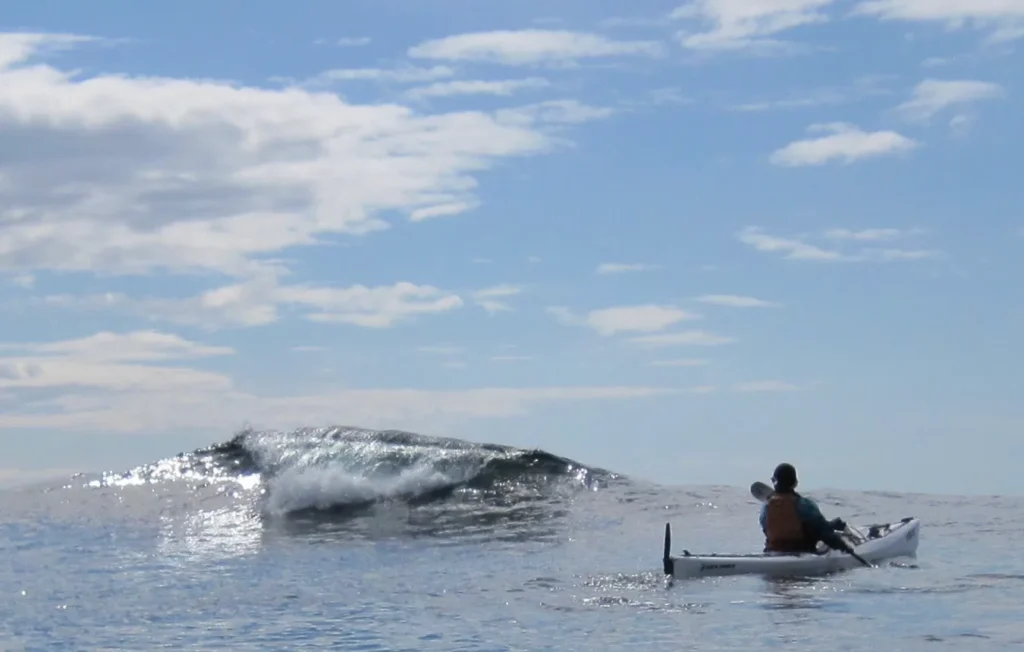
The overall stability feels somewhere between the Xplore and the Xcape and more akin to the Pace Action, all of which I’ve owned. The secondary stability is very good and in terms of forwards paddling performance it seems similar to the Xplore but faster than the Xcape and Pace Action. What is really noticeable is how manoeuvrable it is for a longer kayak. Edging feels stable and almost effortless and more akin to the Pace Action which is a much shorter boat with more rocker (rudder up obviously). However, it does need to be remembered that the speed comes at a cost which is the small loss of stability.
Handling in wind, tide and lumpy seas
I found that in a bouncy tide-race on Anglesey where I did need to concentrate and to relax as the unladen kayak was quite lively. That said, I would usually paddle my Romany Surf if we were playing in a tide-race, so it’s a good test of the Xceed. It felt the same in windy and very lumpy conditions unladen on Harris, you just need to relax and trust in the secondary stability as the kayak is capable, its more about the paddlers ability.
Expedition-proof
As a fully laden boat on multiple days out I found the Xceed to be fast and very easy to paddle with no loss of manoeuvrability and capable of eating up all my kit with room to spare. The increase in weight definitely improves stability, and that’s what you would expect. In short, it works well as a day boat but really comes into its own carrying kit on expedition. Whilst on Harris I swapped boats for a while and paddled a fully laden Cetus HV. The pal I swapped with stated that the Xceed was less stable than his Cetus but with excellent secondary stability and a really comfortable cockpit, particularly the backrest. Whilst the Cetus is a good boat, compared to the Xceed its a bit of a tub. Absolutely it has more stability, but I was getting pretty tired paddling it and couldn’t wait to return to my Xceed. With no disrespect to the Cetus, which is a great boat with a proven pedigree, getting back in my Xceed felt like swapping a cart horse for a racehorse.
Skeg up or down?
As you would expect, the Xceed needs the skeg to be deployed as the wind strength increases but not excessively so as I found when I paddled the Cetus HV when the skeg was never up. In a Fore 5 gusting Force 6 unladen the Xceed needs all of the skeg deployed with the wind beam on, which is to be expected, and it never proved to be a handful. I had no issues at all with rolling the kayak.
In summary, I’m very happy with my Xceed and will be keeping it as my day paddling and expeditioning boat.
Contact me if you’d like to submit your own review